Drishyam: How a Small Malayalam Thriller Became Bollywood’s Most Unlikely ₹550-Crore Franchise
Every rule of the Bollywood franchise says Drishyam should have shrunk. It is a remake of a Malayalam film with no songs built for chartbusters, no larger-than-life hero, no universe-building, and a hero whose superpower is running a cable TV business. The first Hindi instalment earned a modest ₹110 crore worldwide. The third is nearing ₹550 crore.
All box-office figures in this guide are trade estimates (Sacnilk, Bollywood Hungama) as of 20 October 2026. Drishyam 3 is still running in theatres, so its figures are not final.
The Drishyam franchise has done the one thing almost no Indian franchise manages: every sequel has outgrossed the film before it — and by multiples, not margins. Here is how a ₹3.5–5 crore Malayalam thriller became Bollywood’s most unlikely box-office phenomenon.
The numbers first: a franchise that grows backwards
The Hindi series, film by film (worldwide gross, trade estimates):
| Film | Year | Director | Worldwide gross (est.) |
|---|---|---|---|
| Drishyam | 2015 | Nishikant Kamat | ~₹110 cr |
| Drishyam 2 | 2022 | Abhishek Pathak | ~₹345 cr |
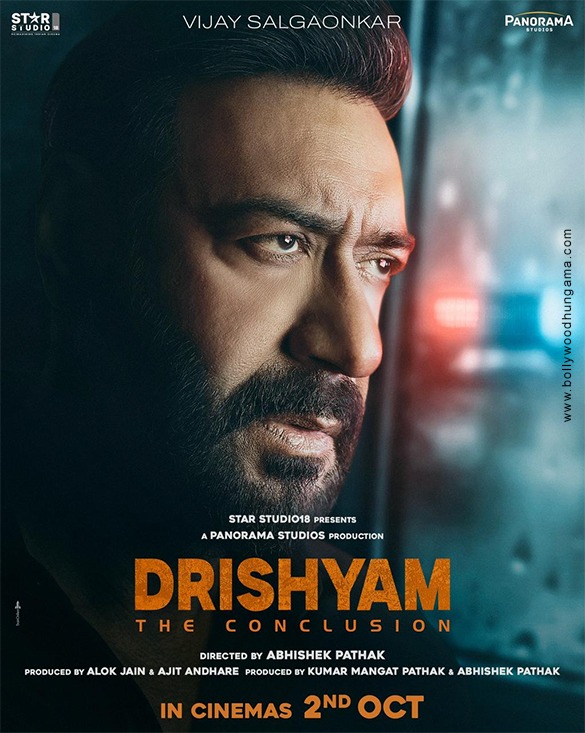
| Drishyam 3: The Conclusion | 2026 | Abhishek Pathak | ~₹548 cr (still running) |
To put the arc in perspective: the third film earned 2.6 times the entire lifetime collection of the first film in its opening weekend alone (₹174 crore in three days versus the original’s ₹67.13 crore India net lifetime, per Bollywood Hungama). Sequels in India normally open big and fade; Drishyam opened modestly and compounded.
Where it began: a 2013 Malayalam film with a universal premise
The story starts with Jeethu Joseph’s Drishyam (2013), starring Mohanlal as Georgekutty, a cable TV operator in a Kerala village whose family becomes the prime suspect in a missing-person case. Made on a reported budget of just ₹3.5–5 crore, it ran in theatres for over 150 days and grossed roughly ₹62–75 crore worldwide — enormous for its scale at the time.
The premise is why it travelled: an ordinary father, an extraordinary situation, and a puzzle the audience can try to solve alongside the hero. There is nothing culturally locked about a family protecting itself from the police. That universality is what made the next chapter possible — and extraordinary.
The five-language remake map: a chain Indian cinema had never seen
The Malayalam original was remade in four other languages, each a local star vehicle:
- Kannada — Drishya (2014), starring Ravichandran
- Telugu — Drushyam (2014), starring Venkatesh
- Tamil — Papanasam (2015), starring Kamal Haasan
- Hindi — Drishyam (2015), starring Ajay Devgn, directed by Nishikant Kamat
When the Malayalam sequel Drishyam 2 arrived in 2021 (direct to Amazon Prime Video, no theatrical release), the remakes followed again: Telugu’s Drushyam 2 (2021), Kannada’s Drishya 2 (2021), and Hindi’s Drishyam 2 (2022). The Hindi version, now directed by Abhishek Pathak after Nishikant Kamat’s death in 2020, became the second-highest-grossing Hindi film of 2022.
And then the chain did something unprecedented: it broke. The Malayalam Drishyam 3 (“The Past Never Stays Silent”) released theatrically on 21 May 2026 and grossed roughly ₹236 crore worldwide — but the Hindi Drishyam 3 is not its remake. It is an original script, “The Conclusion,” written specifically as the Hindi series’ own ending. There will be no Telugu or Kannada remakes of part 3 either. After following the Malayalam films for over a decade, the Hindi franchise has become its own thing — a first for an Indian remake franchise.
Why it grew: four reasons sequels usually don’t get
1. The story had somewhere to go. Most sequels invent a new threat. Drishyam didn’t need to: the buried body from part one is a narrative engine. Every sequel asks the same unbearable question — what happens when the cover-up starts to crack? The audience returns not for a bigger villain but for the same family under new pressure. That is a renewable premise, not a repeatable formula.
2. Continuity of character, not escalation of scale. Vijay Salgaonkar is the same cable operator in 2026 as in 2015. Tabu’s Meera Deshmukh — the rare antagonist who survives and returns across all three films — keeps the emotional stakes personal. The franchise never inflated into set pieces; Drishyam 2 was reportedly made for ₹50 crore, a fraction of what a typical ₹345-crore grosser costs. Thriller economics: when the budget is modest, every crore of growth is profit, and the film doesn’t need a record opening to survive.
3. Word of mouth compounds. The first film was a slow-burn success; the second opened to ₹15.38 crore and legged it to ₹240.54 crore India net on reviews and conversation. By the third, the franchise had converted a decade of goodwill into event status: a Gandhi Jayanti release, the fourth-biggest Hindi opening day ever (₹62 crore net), and a “conclusion” label that told audiences this was the last chance to see the story end in a theatre.
4. It respected the audience’s intelligence. Drishyam’s twists are constructed as fair-play puzzles — the clues are on screen, and the pleasure is in rewatching to catch them. That rewards repeat viewing and, crucially, rewards the viewers who recommend it. A franchise built on “you have to see how they did it” markets itself.
Two endings, one franchise
Here is the genuinely historic part. In 2026, Indian audiences got two Drishyam 3s: Jeethu Joseph and Mohanlal’s Malayalam film in May, and Abhishek Pathak and Ajay Devgn’s Hindi “Conclusion” in October — different scripts, different endings, same characters. Ajay Devgn has said publicly that the Hindi team deliberately did not copy the Malayalam film, and that he personally called Mohanlal to ask him to watch it.
No Indian franchise has ever split like this: the remake outgrowing the original to the point of writing its own finale. The Malayalam series may yet continue — Joseph has spoken of a possible Drishyam 4 — while the Hindi series is billed as concluded. Both can be true at once.
The bigger lesson
The Drishyam story is really a story about what Indian audiences are assumed to want versus what they actually reward. The industry’s franchise playbook says: scale up, go bigger, add spectacle. Drishyam did the opposite for eleven years — same family, same village logic, same question — and grew from ₹110 crore to ₹550 crore.
The lesson isn’t that thrillers beat action films. It’s that a franchise is not a brand to be extended; it’s a promise to be kept. Drishyam kept its promise three times: an ordinary man, an impossible situation, and a solution you could have seen coming if you’d been paying attention. Audiences paid attention — in five languages, for thirteen years, and counting.